Types of trading event
Capital Raise
A capital raise is a trading event where a business offers newly issued financial products - such as shares or units in a fund — at a fixed price. Investors can submit orders to buy these financial products on a first come, first served basis.
Once the capital raise closes (or at intervals during the raise), the business issues the new financial products to investors. Until they are issued, you'll see your pending investment order in your dashboard and any funds you've paid held in your Catalist wallet.
Continuous Investment Offers
Some capital raises are structured as Continuous Investment Offers. This means you can usually invest at any time. This is common for managed funds and similar products, although there may be times when the offer is not open for new investment, for example when a fund is being revalued. Please check the relevant marketplace page for details on how often new financial products are issued. For example, some businesses issue new shares or units to all new investors once each month.
Commitment raises
In some capital raises, you may be asked to submit a dollar commitment rather than requesting a specific number of financial products. This approach is often used for wholesale capital raises, or managed funds where your investment may be drawn down over time. The relevant marketplace page will explain the terms of any commitment raise, including how and when your committed funds may be called.
Secondary Market Trading Event
Secondary Market Trading Events are designed to allow investors to either buy or sell the financial products— such as shares or units in a fund — at a price determined by the balance of supply and demand. We provide several protections to ensure trading is fair, orderly and transparent.
To support businesses at different stages of their journey, we offer two complementary liquidity pathways:
- Structured Liquidity Programme (SLP)
This is a guided first step for businesses that are new to secondary market trading or that have a temporary imbalance between buy side and sell-side demand. Our Structured Liquidity Programme is designed to create a sustainable, long-term market that is fair to all investors by minimising artificial or short-term price fluctuations that can be driven by a small number of investors. SLP uses a two-stage process to securely and fairly match sellers and buyers. - Open Market Auction (OMA)
OMA is designed to create a fair and efficient market by determining the best possible clearing price based on all supply and demand at the time of the auction. Buyers and sellers can submit orders at the same time, with the auction setting a single price based on competitive bidding.
Both methods are underpinned by Catalist's commitment to fairness, clarity and orderly market operation. Below, we explain how each works and what investors can expect.
The trading process
Structured Liquidity Programme (SLP)
A guided first step for businesses building a healthy market for investors
SLP uses a two-stage process to securely and fairly match sellers and buyers.
Stage 1: Sell-Side offers
The purpose of this stage is to collect all selling interest from existing investors without encouraging competitive undercutting.
During this stage:
- Investors who want to sell indicate the quantity they wish to sell and the lowest price they are willing to accept.
- A live, anonymised order book shows the range of sell prices, helping sellers make informed decisions.
- At the end of the stage 1, all sellers may match the lowest sell price, which removes any incentive to undercut the fair price that you think buyers will pay.
- Any shares that do sell are allocated to the relevant sellers pro-rata based on each seller's existing holdings, ensuring fairness between sellers.
This process establishes a single lowest sell price and a total quantity available from all sellers willing to accept that price. This price becomes the offer price for Stage 2.
Stage 2: Buy-Side orders
Investors are given the opportunity to buy the financial products (i.e. shares or units etc) at the lowest sell-price determined in Stage 1.
Investors can usually submit orders to buy these financial products on a first come, first served basis.
In some cases, for example where shareholders have pre-emptive rights, the business may choose to offer the shares to existing investors (excluding the sellers) pro rata to their existing holdings. This means each existing investor can choose to buy their relevant proportion of the financial products offered and optionally request a portion of any shares that other existing investors choose not to buy - this is called an 'oversubscription' request. If any financial products remain unsold after existing investors have had access, the business may choose to offer them to new investors.
If all offered financial products are purchased at the lowest price identified in Stage 1, the process may be repeated at the next lowest price. All remaining sellers from Stage 1 are offered the opportunity to reduce their sell price to that next lowest price, and those financial products are then offered at that price to the buyers.
Open Market Auction (OMA)
A transparent auction process for ongoing secondary-market trading
Open Market Auctions are designed to create a fair and efficient price based on all supply and demand at the time of the auction. All buyers and sellers willing to trade at the closing price get the same closing price in a single transfer at the end of the auction.
OMA consists of three periods: Auction Pre Open, Auction Open, and Auction Pre Close, followed by Settlement.
Auction pre-open
Before each auction:
- Businesses provide updated information for investors.
- Investors can review financial and business disclosures on the relevant Marketplace page.
This ensures all investors enter the auction with the same set of information.
Auction open
During this period:
- Investors can submit, edit, or cancel bids (to buy) and offers (to sell).
- A live indicative price is displayed based on current supply and demand.
- Investors can see whether their orders are currently likely to be successful by checking the status in their dashboard.
- Auctions usually last about one week, with timings clearly displayed on the relevant Marketplace page.
- The open period may extend if large orders are placed in the final minutes (with a slightly randomised end time to reduce the risk of manipulation).
- Any order not cancelled before the end of this period becomes binding and cannot be withdrawn.
If we believe an order is unusual, a mistake or potentially manipulative, Catalist reserves the right to hold the order outside the order book until it has been reviewed by Catalist's regulatory team. Orders may be released back into the orderbook after our review - any such orders retain their original time priority as though they had not been delayed.
Auction pre-close
After the open period:
- Only investors who have already placed an order may improve it. These investors can improve their price and/or the quantity of their order by up to 10%.
- No new orders or cancellations are allowed.
- Improvements made in the final minutes of the period may cause the period to be extended to ensure fairness.
- The end-time of the period may be randomised slightly to avoid last moment gaming.
Although investors are not entitled to cancel bids and offers during the pre-close period, we reserve the right to allow cancellation or amendment, at our discretion, if an investor promptly contacts us and can show the bid or offer was a genuine mistake.
Auction close
Provisional auction results are made available after the auction has closed. Investors with successful bids or offers are legally obligated to complete their transaction and we may complete the transaction on their behalf.
If for any reason, an investor does not honour their bid, we may either cancel that investor's bid (in whole or in part) or transfer that investor's bid to another person. If the bid is cancelled, we will recalculate the results of the auction. This may affect the final price of the financial products, or which bids and offers are successful.
If an investor has only part-paid for their bid, we may choose to accept part of that bid and cancel the remainder, so the bid effectively becomes a bid for a smaller volume, at the same price.
Once all outstanding payments are confirmed, Catalist completes the transfers from all successful sellers to the buyers in accordance with our Electronic Transfer System Rules. The records in investor accounts are updated, and payments are made to sellers. Unsuccessful bidders can request a refund of any money in their Catalist wallet.
Catalist aims to complete this process (called 'settlement') within 5 business days, although it is often much quicker.
The order book.
The order book is the total collection of all valid bids and offers submitted during an auction period. It is used to calculate the final price to be paid for financial products. Bids and offers are recorded based on the time they are submitted and the price at which the investor is prepared to buy or sell. See a video explaining how the order book works here.
The fair price for the financial products is calculated using the following process:
1
Step 1
Our platform first finds the price at which the greatest quantity of shares can be traded.
2
Step 2
If there is more than one price at which the same maximum number of financial products would trade, then the platform selects the price(s) within this range, where the 'order imbalance' is minimised (the difference between cumulative bids and offers).
3
Step 3
If there is more than one price at which the order imbalance is minimised, then:
- If there is excess buyer demand at all these prices, the platform selects the highest of these prices; or
- If there is excess seller demand at all these prices, the platform selects the lowest of these prices.
4
Step 4
If there is more than one price at which the order imbalance is minimised, but there is excess buyer demand at one or more of these prices, and also excess seller demand at one or more of these prices, or zero order imbalance at more than one of these prices, then the platform selects the price, within this range, that is closest to the price the financial products most recently traded at, in an auction.
5
Step 5
If step 4 fails to set the price because the financial products have not previously traded in an auction, then the platform selects the lowest of the prices at which order imbalance is minimised, and at which there is either zero order imbalance or excess offer (seller) demand.
EXAMPLE
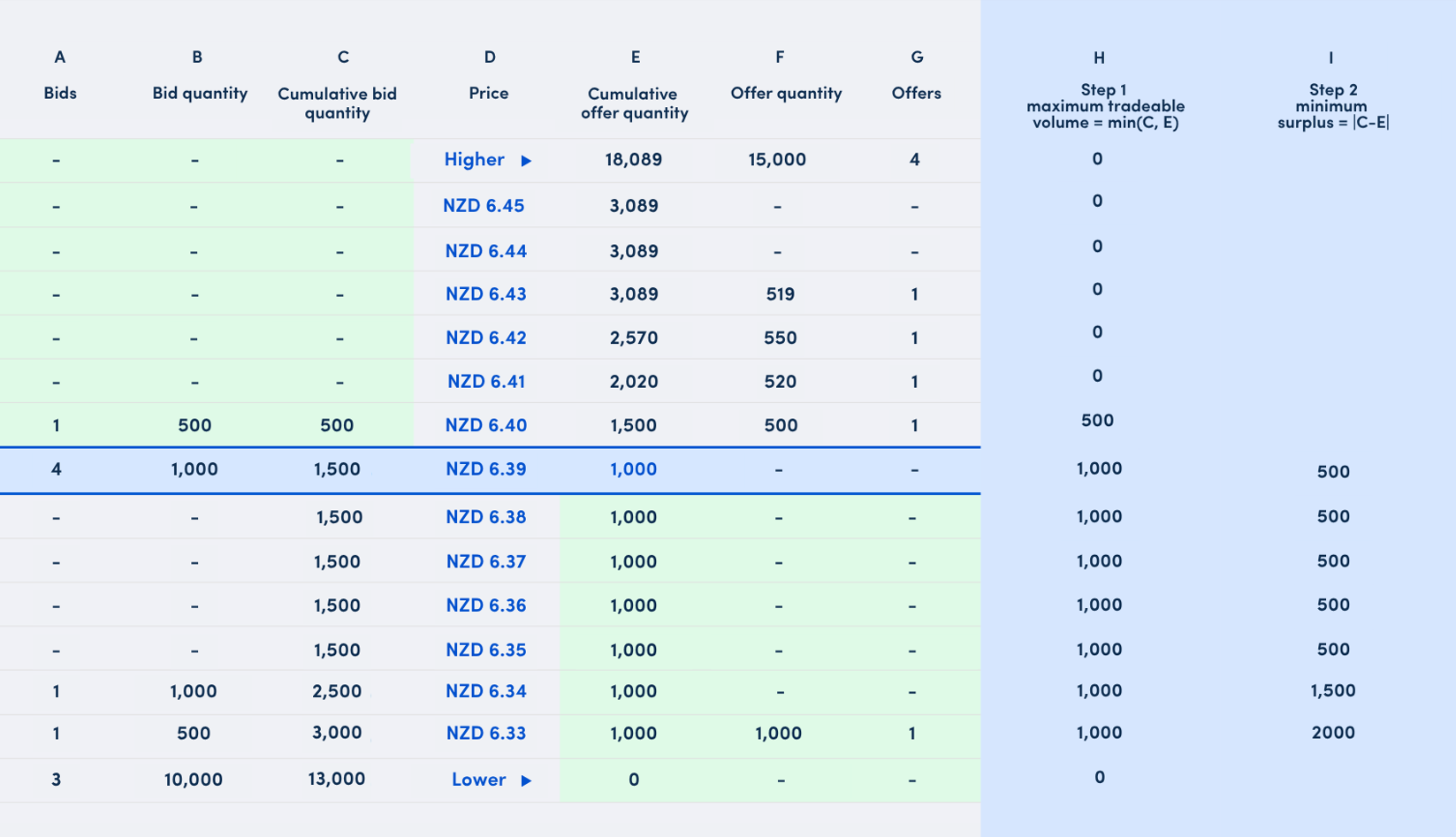
The table below shows, for an auction, all the bids to buy a financial product (column B), and offers to sell (Column F), for each possible price (column D). Column C shows the cumulative demand to buy at each price, and column E shows the cumulative demand to sell at that price.
Step 1
A maximum quantity of 1000 financial products would trade, if the price was set between $6.33 and $6.39 (see column H).
Step 2
The order imbalance would be minimised at 500 if the price was between $6.35 and $6.39 (see column I).
Step 3
There are excess buy orders (1500) over sell orders (1000) for all price levels between $6.35 and $6.39, therefore the algorithm selects the highest of these prices. The price for all financial products traded will be $6.39.
Step 4 & 5
There is no need for the algorithm to consider step 4 or 5.
Priority bids and offers
For all limit orders, bids and offers are given priority based on the competitiveness of their prices and the time at which they were submitted.
Bids to buy at a higher price are more likely to be successful than bids at a lower price.
Offers to sell at a lower price are more likely to be successful than offers at a higher price.
For bids or offers submitted at the same price, the bid or offer submitted earlier in the auction has priority, so is more likely to be successful.
Auto bids and auto offers are prioritised based on the limit orders that are submitted into the order book pursuant to the auto bid or auto offer. Auto bids and auto offers update their prices in the order they were submitted, so the first in time retains priority if bidding at the same price.
Updating existing orders
If you update an existing bid or offer, the time priority of that bid or offer will be reset (unless the only change is a reduction in the volume of a limit order and the limit price remains the same – in which case the order will maintain its original time priority).
Increasing existing orders
If you want to increase the size of an order at the same limit price without losing the time priority of your existing order, you can do this by submitting an additional order at the same price, for the incremental increase in volume, instead of amending your existing order. Make sure you select the option to submit an additional order rather than replacing your previous orders.
Auto bids and auto offers
Use the auto bid or auto offer function to automatically improve your bid or offer, if it is outbid, up to your specified best price.
When you submit an auto bid or auto offer, your price is submitted as a standard limit order. If your price is outbid, it is automatically withdrawn and re-submitted at incrementally better prices, up to your specified best price. This means your best price won’t necessarily be submitted immediately into the order book – only the price that is sufficient for your order to trade to the maximum extent possible.
If there are no existing orders that your auto bid or auto offer could trade with, nothing is submitted into the order book until there is an order it can trade with. If your auto bid or auto offer is outbid at its best price, it will remain in the order book at its best price, unless you withdraw it, as new orders could be submitted that allow your order to trade in whole or in part.
Investors only see the limit orders that are actually submitted into the order book. No one else sees the details of your auto bid or auto offer best price.
EXAMPLE
Ben submits an auto bid to buy 10,000 shares at a best price of $1.20 per share. Based on the current auction order book, if the auction were to close at that moment a limit order bid for 10,000 shares would successfully trade in full at $1.01, but would not trade in full at $1.00.
Ben’s order is therefore submitted into the order book as a limit order for 10,000 shares at $1.01, and other investors will be able to see this anonymous limit order at $1.01 in the order book.
If other more competitive bids are submitted that cause Ben’s order not to trade in full, his limit order is withdrawn and replaced with an improved limit order, for example it might improve to 10,000 shares at $1.03. Ben’s order will continue to be improved if necessary, up to the maximum of 10,000 shares at $1.20.
The pros and cons of auto bids and auto offers
Auto orders allow you to ‘set and forget’. There’s no need to log in to the auction when it’s closing to try to outbid other investors.
If you submit an auto order, a later limit order at the same best price may take priority over your order if the price submitted into the order book for your auto order had not reached your best price before that limit order was submitted.
Auto orders can help to avoid disorderly pricing that could result from an investor submitting a very aggressively priced order – the investor is likely to receive better pricing and there are less likely to be unfair price fluctuations using auto bid and auto offer.
For this reason, if you wish to submit a bid to buy financial products at a price much higher than the expected price, or you want to offer to sell financial products at a price much lower than the expected price, we may require this to be done by an auto bid or auto offer rather than by a limit order.
Don’t worry – other investors won’t be able to take higher priority by submitting a limit order, because we will require all investors to use auto orders based on the same thresholds.
Partial trades
It is possible that some bids and offers will trade in part, which means the investor will buy or sell a smaller number of financial products than the maximum amount indicated in their order.
EXAMPLE
Catalist’s auction algorithm sets a price for shares in ABC Limited at $1.10 per share. At this price, sellers were willing to sell a total of 10,000 shares, but there were 3 investors who submitted bids to buy a total of 12,000 shares:
Aroha submitted the first bid to buy 5,000 shares at $1.10 (or below). Ben submitted the second bid, to buy 2,000 shares at $1.15 (or below). Colin submitted the last bid, to buy 5,000 shares at $1.10 (or below).
Ben’s bid is the highest price, so he trades first. Ben will purchase the 2,000 shares he wants at the price of $1.10 per share (Ben gets a better price than the maximum he was prepared to pay).
Aroha and Colin’s bids were at the same price, but Aroha’s bid was first in time, so she gets priority. Aroha will purchase the 5,000 shares she wants at $1.10 per share.
Colin will purchase the remaining 3,000 shares at $1.10, but he won’t get the full 5,000 shares he was prepared to buy.
Exercising rights and options
If you have rights or options to purchase any financial product recorded in the Catalist platform, you can exercise your rights or options through your Catalist dashboard. Please follow the instructions sent to you by the relevant business to exercise your rights or options.
